
Peach County Civil Docket Searches
Superior civil cases cover broad civil disputes, domestic relations, divorce, equity, and title-to-land matters. Georgia Courts routes Peach Superior e-access through PeachCourt, which requires registration or login. So does the Clerk's Icon Case Management screen. Small claims and other limited civil matters are different. The Georgia Magistrate Records civil search is a public form. PEACH appears as a county choice there.
Before searching, gather the party name, court, case type, case number, and approximate filing date. Official Superior calendar examples use YY-V-NNNN. Every hyphen must be preserved when you type it in. The Magistrate portal accepts a case number or first and last name. It can narrow results by file type and several date ranges. Nothing turning up? Confirm the court and the spelling before you call the clerk.
- Choose Superior Court for general civil, divorce, equity, or land-title work, or Magistrate Court for its listed limited civil matters.
- Use PeachCourt for Peach Superior, or select PEACH in the public Magistrate search.
- Enter the exact case number first. Use a party name if that search choice is supported.
- Compare filing, service, answer, judgment, and disposition dates instead of treating them as one event.
- Contact the correct clerk for an omission, older paper file, certified judgment, or document that the index does not provide.
Peach County Civil Search Filters
The Magistrate civil portal is the easiest anonymous civil search available to Peach County users. One caution applies. It covers Magistrate records only. So it is not a Superior Court search, and it proves nothing about whether a Superior civil case exists. The file-type menu helps separate common claims. The date controls trim a broad party-name result without guessing at unsupported wildcard rules.
| Search field | Use | Peach County note |
|---|---|---|
| County | Select jurisdiction | Choose PEACH |
| Last / First Name | Party-name search | Try exact spelling before narrowing dates |
| File Type | Limit the civil category | Includes claims, dispossessory, garnishment, foreclosure, and listed property matters |
| Case Number | Direct lookup | Best key when known |
| File Date | From/to range | Tracks when the filing entered the court |
| Judgment Date | From/to range | Not the same as filing or service |
| Disposition Date | From/to range | Tracks the recorded outcome date |
The public portal also displays adjacent tabs for ordinance violations, deposit-account fraud, and arrest warrants. Do not confuse those with the Superior civil docket. Search only the category that matches the case. Then ask the Magistrate clerk to confirm any result you must rely on.
The official Magistrate search source lets readers recognize the county selection and filing controls. Those appear on the court's own page.
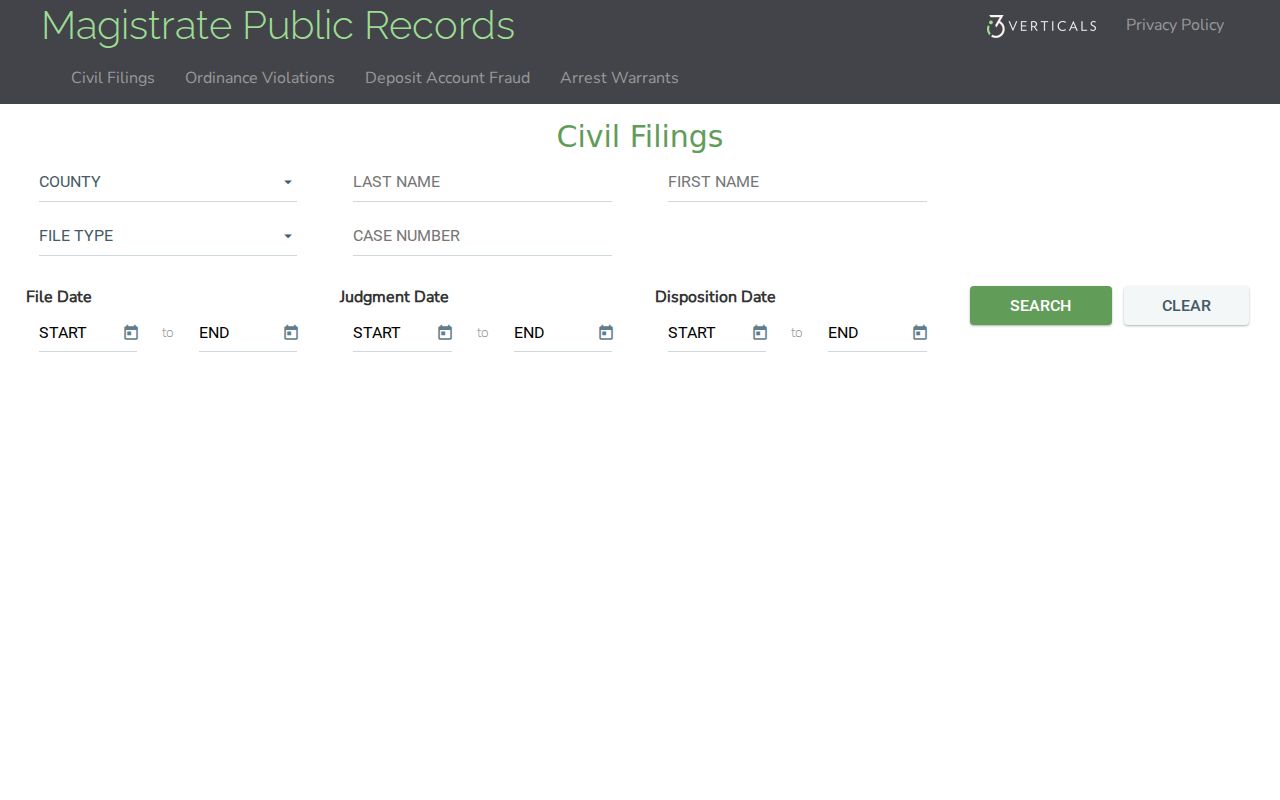
The form shows why county selection and file type matter. A result from this tool is a public index entry, not a certified copy.
Civil Dockets: What They Show
What does a Peach Superior civil calendar preview show? It identifies the court and calendar call, the presiding judge, the date and time, the case number, filing date, cause, party roles, service and answer dates, attorneys, and the represented side. Think of it as a scheduling view. It is not the complete civil case file, and it will not necessarily show every pleading image, exhibit, fee, judgment amount, order, or transcript.
| Case number | A court identifier such as the sample pattern YY-V-NNNN. |
|---|---|
| Cause and parties | A short case description with plaintiff and defendant roles. |
| Filing date | The date the action or paper entered the court record. |
| Service date | The date process was served, which may start a response period. |
| Answer date | The filed or due date for the response; it is distinct from service. |
| Setting or judgment | A hearing event or recorded outcome, depending on the record being viewed. |
A docket entry and a document image are two different products. Under its access terms, PeachCourt may provide a linked image, while the Clerk of Superior Court supplies official copies and certification. Read the chronological entries first. Then request the exact pleading, order, or judgment you need.
Peach County Civil Calendar Calls
The local Superior calendar carries the title "Civil Calendar Call." That label marks a scheduling or status event. Civil cases are grouped there for court attention. It is not a trial judgment. It also does not mean every listed case will be fully heard that day. The service and answer columns can show where a case stands before a later motion, hearing, or ruling.
Note the case number, judge, calendar date, and counsel columns. Then compare them with the live case information. One limit matters here. The Clerk's online calendar index contains visible entries from 2020 and 2021. So it works as a source for local terms and sample fields but not as a dependable current setting list. Call the Clerk of Superior Court at 478-825-5331 to confirm a present setting.
Note: A calendar call is a setting in the civil docket, not proof that a final judgment was entered.
What Cases Fill the Civil Docket
Jurisdiction decides which Peach County civil docket holds a dispute. Superior Court has broad authority over general civil matters. It also holds exclusive authority over divorce, equity, and title-to-land cases. Magistrate Court handles civil claims up to $15,000. Its public portal shows specific limited proceedings too. Probate keeps its own record for estates, wills, and guardianships. The county administrative clerk does not keep these court case files.
- Superior general civil disputes, domestic relations, divorce, equity, and land-title matters
- Magistrate statements of claim and other civil claims within the court's limit
- Dispossessory and writ-of-possession proceedings in Magistrate Court
- Garnishment, foreclosure, and interrogatory filings shown in the Magistrate system
- Abandoned property, abandoned vehicle, and mechanic's lien categories listed by the portal
A case that moves on appeal or transfer can acquire a different controlling file. Ask both clerks which number applies after that move. The earlier Magistrate record and later Superior record may each hold part of the procedural history.
Peach County Civil Court Comparison
Superior and Magistrate civil dockets overlap in the broad sense that both involve noncriminal disputes. Their authority, portals, and clerk channels differ, though. Pick the court before searching to avoid a false "no record" result.
| Point | Superior civil | Magistrate civil |
|---|---|---|
| Typical scope | General civil, divorce, equity, land title | Claims up to $15,000 and listed limited matters |
| Online route | Account-based PeachCourt and Icon login | Public Georgia Magistrate Records search |
| Search controls documented | County, court, exact case number; party name where supported | Name, number, file type, file date, judgment date, disposition date |
| Official copy | Clerk of Superior Court | Magistrate Court clerk |
| Online filing | PeachCourt e-filing route | Official cost page says online filing is unavailable |
That last distinction matters more than it looks. The Magistrate docket can be searched online even though the court's cost page says online filing is not available. Search access and filing access are separate functions.
Hearings on the Civil Docket
Start with the setting itself. A Peach County civil hearing may appear on a calendar, inside the case information page, or in a scheduling order already on file. Confirm the date, time, judge, and setting type. Service and answer events drive what happens next. That is especially true in Magistrate Court. The court's procedures give a defendant 30 days to answer, then a 15-day late-answer period with costs, and after that the claimant must request default judgment in writing.
A reset just moves the hearing. The case stays alive. Only the Magistrate judge grants continuances, and absent an emergency the request should reach the court at least five days before the hearing. Calendars go stale, so confirm any setting that affects attendance with the clerk.
- Service
- Delivery of legal process that can start a response deadline.
- Answer
- The defendant's formal response, with its own filing or due date.
- Continuance
- A court-approved move of a setting to another date.
- Default judgment
- A judgment sought after the response period passes; Peach Magistrate requires a written request.
Peach County Civil Filing Costs
The Peach County Magistrate fee page sets out the court's filing and copy charges. A statement of claim or foreclosure runs $109 for one defendant and $159 for two. Garnishment is $109. Dispossessory costs $84 for one defendant and $109 for two. An abandoned motor vehicle filing is $25. Copies run $0.50 regular and $5.00 certified.
Payment rules are strict. The page accepts checks or money orders only; cash and credit cards are not taken, and online filing is unavailable. Subpoena and sheriff-service charges can add up. Fees change, so confirm the current total before you file or order a copy.
A fee is only the first step. The official Magistrate procedures page shows the sequence behind these filings, from service and answer to hearing and continuance.
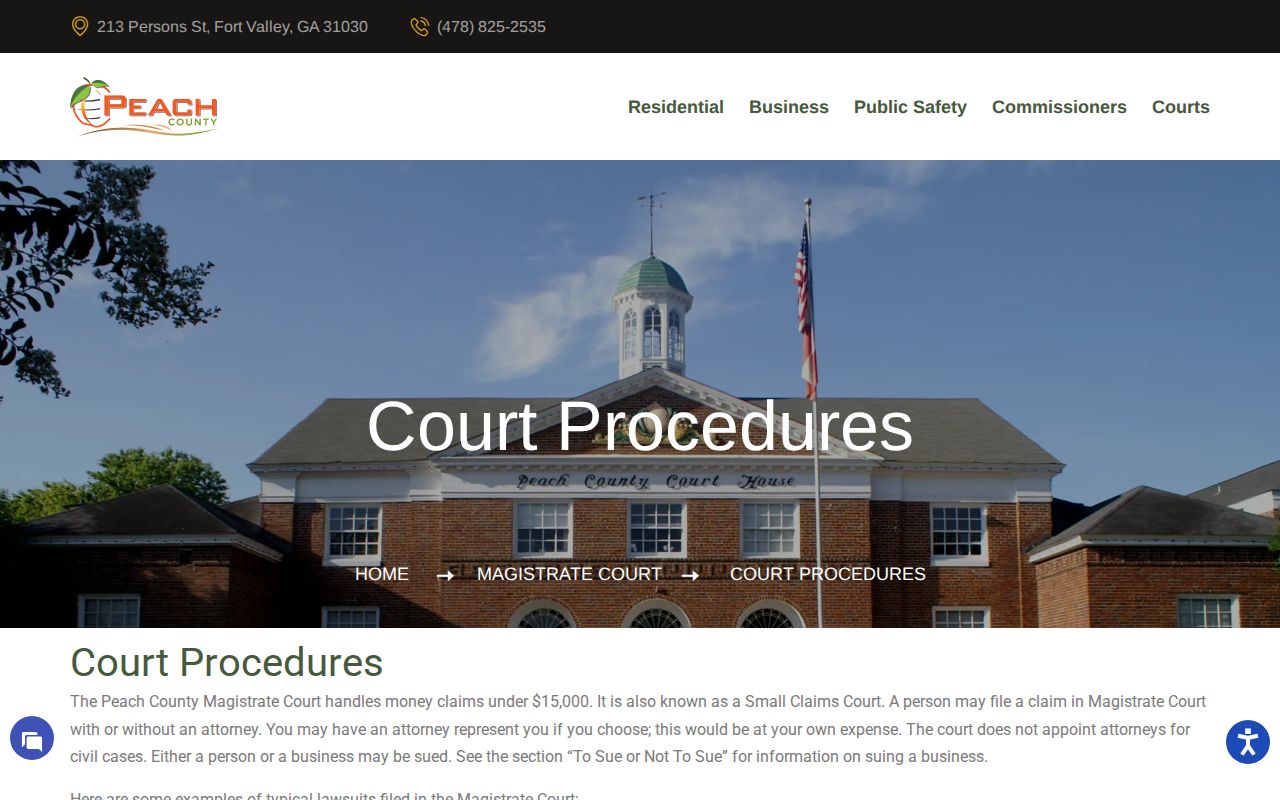
A fee starts the clock. The procedure page then separates the filing date from service, the answer, the hearing, and any later default request.
Who Can See Civil Dockets
Most Peach County civil dockets are open to anyone. Sealed orders, protected identifiers, some family matters, and material under a specific exception may be withheld or redacted. Georgia's electronic-filing standards treat an e-filing the same as paper for public access, subject to those limits. Viewing online can still cost a provider fee. Access alone does not certify the image. A certified copy must come from the clerk.
Georgia access rules:
O.C.G.A. §§ 50-18-70 through 50-18-72 provide the public-record framework, response process, fees, and exemptions. Trial exhibits have special access treatment.
Uniform Superior Court Rules 21 and 21.6 govern limits on Superior court-file access and protected identifier pages.
Send the request to the right court clerk. The Peach County administrative clerk keeps Board of Commissioners records and redirects court requests elsewhere. Put yours in writing. Name the court, case number, record sought, approximate date, and preferred format, and the clerk's office may respond with a fee, production time, redaction, or a legal exemption.
Peach County Civil E-Filing
PeachCourt plays two roles here. It is the identified Peach County Superior Court civil e-filing route. It also doubles as an account-based e-access layer. You must register and log in before any search controls appear. The support material walks through the workflow: Search, then Cases, then County and Court, then an exact-format case number. Nothing in that material documents wildcard, birth-date, or anonymous date filters. Stick to what the system supports.
The PeachCourt case search page is the Superior civil access layer.

That login wall explains the difference. A public provider listing is not the same as an anonymous case result. Registration is open, though. An older file, a missing docket entry, or a certification need still falls back to the Peach County clerk.
Statewide, Georgia offers a provider directory. The Georgia Courts e-file directory names approved systems and standards rather than one universal public Peach County docket.
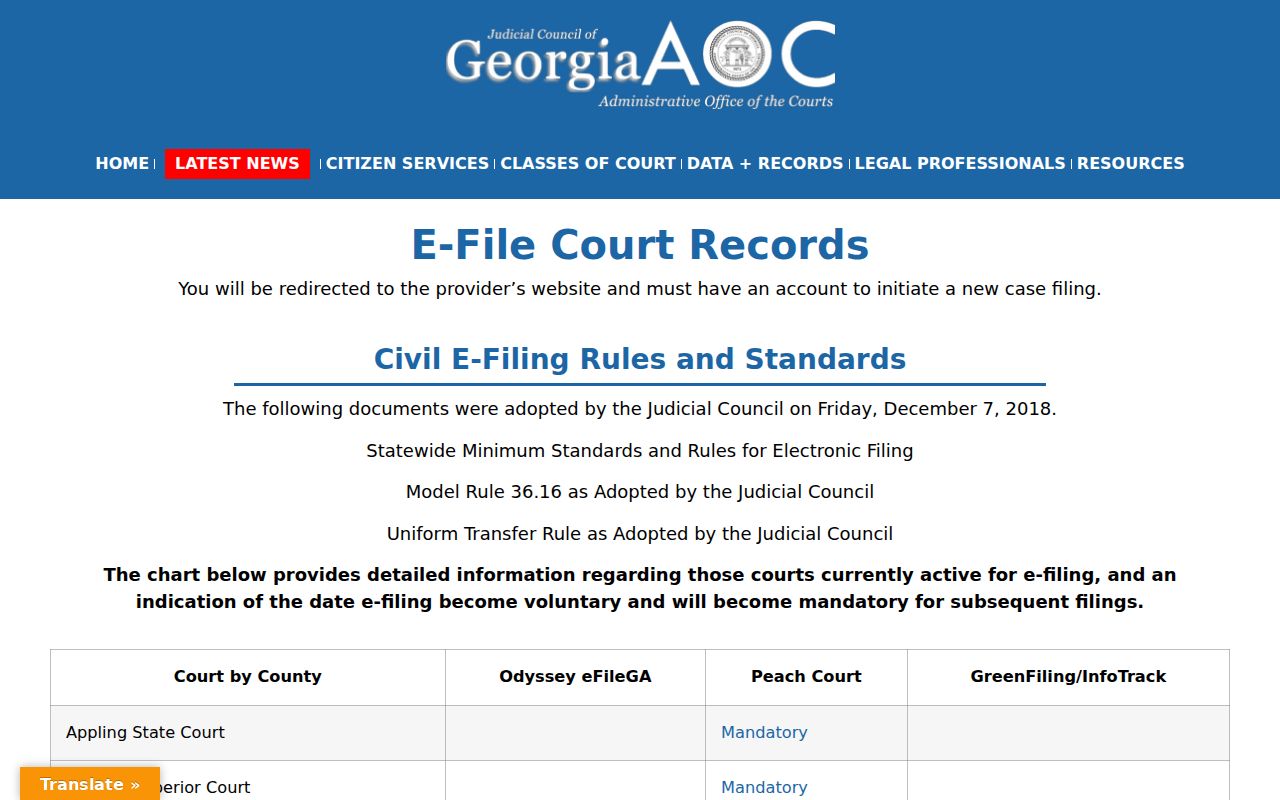
The directory points you to the right provider. It merges nothing, and Superior and Magistrate records stay with their own Peach County clerks.